
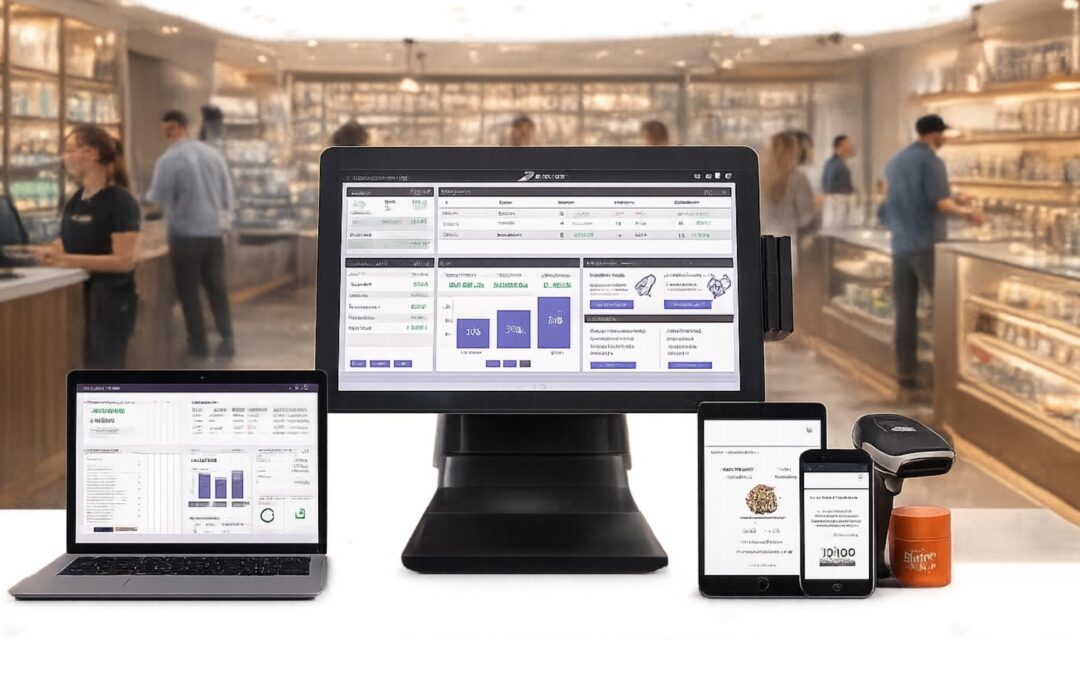
Choosing between TechPOS and Cova depends on how much manual work your team can absorb for compliance reporting, how quickly you need support when something goes wrong, and how cleanly your POS can scale to new locations. TechPOS is a Canadian-built cannabis POS that files AGCO and BCLDB reports directly with regulators, with no manual exports required. Cova is a North American platform with strong Canadian adoption, automated compliance features, and dedicated account manager support at every tier. If you’re operating or planning a compliant cannabis POS built for Canadian dispensaries, the difference between native regulatory integration and configured add-ons matters more than most operators realize before their first audit.
Key Takeaways: TechPOS vs Cova for Canadian Dispensaries
- TechPOS files AGCO Federal Reports, Sales Reports, and Periodic Reports automatically, removing manual export steps for Ontario dispensaries.
- Cova provides automated compliance features including real-time ID checks, purchase limit monitoring, and one-click reporting configured for provincial requirements.
- TechPOS support answers phones with real humans seven days a week, and stays on-site during migrations until full operational confirmation.
- Cova offers dedicated account managers for all pricing tiers, with published average phone and chat wait times under 30 seconds.
- TechPOS scales from a single store to 200+ locations without a separate enterprise pricing tier, while Cova’s enterprise configurations require custom pricing beyond the Powerhouse tier.
- Multi-location cannabis POS tools for inventory and compliance work differently across platforms, with TechPOS using AI-driven reorder predictions and Cova offering offline compliance mode for stores with unreliable internet.
- Cannabis analytics that support dispensary buying decisions help multi-location operators track stock trends without pulling data manually from each store.
TechPOS Files Compliance Reports Directly While Cova Requires More Operator Steps
Automated compliance filing means your POS sends required regulatory reports directly to the regulator, with no spreadsheet exports, manual uploads, or reconciliation steps in between. TechPOS automatically files AGCO Federal Reports, Sales Reports, and Periodic Reports directly with the regulator for Ontario dispensaries, with no manual exports or reconciliation spreadsheets required. Worth noting: many operators assume any modern POS can handle Canadian cannabis compliance through add-on modules, but TechPOS was built from the ground up with native direct filing to AGCO and BCLDB, reducing reliance on manual processes that generic or adapted systems often require. Cova provides automated compliance features including real-time ID checks, purchase limit monitoring, and one-click reporting configured for provincial requirements. For a high-volume Ontario store filing monthly, the difference between direct filing and one-click export is typically a matter of minutes per cycle, but the audit trail and error risk differ significantly between the two approaches.
Is Manual Compliance Reporting Still a Liability Risk for Canadian Dispensaries
Manual compliance processes introduce the risk of human error at every step between your POS and the regulator. TechPOS also uses direct regulator integrations to automatically submit BCLDB sales data and inventory reconciliation from daily transactions for British Columbia dispensaries, covering both of Canada’s largest provincial markets. TechPOS enforces automatic per-customer purchase limit checks at the point of sale and generates the CRMFCR and provincial tax filings through a dedicated rules engine, meaning the compliance logic runs inside the system rather than being applied after a data export. Cova’s compliance scope includes product equivalency calculations for edibles and concentrates, and auto-applied taxes as part of its seed-to-sale traceability features for Canadian retailers, which makes Cova a capable choice for operators selling complex product mixes. For dispensaries in Ontario and BC, the key question is whether you want compliance decisions baked into the transaction engine or applied as a layer on top of it.
How Each Platform’s Support Model Affects Dispensary Operations During Crises
A POS support model reveals its true quality on a Sunday afternoon when a till freezes mid-transaction or a compliance submission fails before a monthly deadline. TechPOS support team answers phones with real humans seven days a week and stays on-site during migrations until full operational confirmation. Cova offers dedicated account managers and real-human support for all tiers, with average wait times under 30 seconds, meaning both platforms commit to human-first support rather than ticket-only queues. For a single-location operator, both models generally cover urgent needs during business hours. For a multi-location chain where a support delay can cascade across several stores simultaneously, the distinction between on-site migration presence and remote account manager access becomes a real operational variable.
What Happens to Compliance and Sales When a Dispensary’s POS Support Goes Dark
Cannabis dispensaries operate under tighter consequences for downtime than most retail categories, because an uninspectable POS can trigger a regulatory visit, not just a lost sale. One retailer migrating from another system to TechPOS reported saving over 30% on labour costs through automated compliance and streamlined multi-location management, showing that the support model and the compliance automation work together to reduce the total burden on store staff. For experienced multi-store operators, the practical question is what a two-hour support delay costs across five or ten stores during a peak Friday evening. For new licensees launching their first store, the concern is more likely to be whether someone answers the phone during setup week, when inspection readiness is the only thing between them and an opening day.
What to Look for in Cannabis POS Support Before You Sign a Contract
- Confirm whether phone support is available seven days a week or only on weekdays during business hours.
- Ask the vendor to specify the average response time for urgent POS failure tickets, not just general inquiries.
- Find out whether your migration includes on-site technician presence or remote guidance only.
- Request written confirmation that compliance reporting stays functional during any planned maintenance window.
- Verify whether a dedicated account manager is included in your base tier or only in premium tiers.
- Ask whether support coverage changes after your first 90 days, when onboarding typically transitions to standard service.
Multi-Location Dispensary Chains Need Different Scalability Features Than Single Stores
A POS that works well for one store can become a coordination problem at five locations if centralized reporting, inventory controls, and pricing rules don’t sync automatically. TechPOS processes over $110 million in monthly cannabis transactions across its client base in Canada, reflecting enterprise-scale transaction load handled without a separate infrastructure tier. Cova POS pricing for Canadian dispensaries starts at $399/month CAD for the Boutique tier (with integrated payments) or $459/month without, scaling to $499-$599/month for the Powerhouse tier suitable for multi-store operations. Enterprise-level multi-location setups with Cova require custom pricing beyond the Powerhouse tier, while TechPOS scales from single stores to 200+ locations without a separate enterprise tier, meaning growing chains won’t hit a pricing cliff as they open new locations. For operators planning to open two or three stores in the next 12 months, both platforms handle the workload, but the total cost of scaling and the administrative overhead differ in ways that compound as the chain grows.
Does Centralized Reporting Actually Simplify Compliance at Scale for Cannabis Operators
Centralized reporting reduces compliance errors by eliminating the need to reconcile separate data exports from each store location at month end. Cova supports multi-location operations with centralized reporting and inventory controls, including an offline mode that maintains compliance functions during outages, making it a resilient option for stores in areas with unreliable internet. TechPOS includes built-in AI that learns sales patterns to predict reorders, supporting inventory decisions across multi-location setups without requiring a manager to pull and compare reports from each store manually. You’ll find that chains running ten or more locations benefit most from AI-assisted reorder predictions, because the volume of SKUs and the variance between store-level demand make manual restocking decisions increasingly unreliable.
Switching Your Cannabis POS Carries Real Risk Unless the Migration Plan Is Bulletproof
A POS migration involves moving inventory records, staff profiles, loyalty data, compliance history, and payment integrations, all while keeping the store open or minimizing the closure window. TechPOS successfully migrated all 200+ Canna Cabana locations — Canada’s largest cannabis chain — in a single overnight window with no lost transactions or downtime the next morning, which is the most concrete publicly available evidence of how TechPOS manages large-scale chain migrations. Most vendors recommend scheduling a POS migration during the lowest-traffic window your store has, which typically falls between 2 a.m. and 6 a.m. on a weeknight. For dispensaries switching systems mid-operation, the real risk isn’t the migration itself — it’s the first compliance submission after the switch, when any data mapping error becomes a regulatory problem rather than just a technical one.
Which Dispensary Operators Face the Highest Risk When Changing POS Systems Mid-Operation
High-volume stores and multi-location chains carry the most migration risk because any data gap or transaction error multiplies across more registers, more SKUs, and more compliance reports. The urgency is especially real for dispensaries switching systems when a provincial inspector is expected, since inspectors need to see the POS system in use and every transaction accounted for in the compliance record. Pro tip: before committing to any POS migration, ask the vendor specifically how they handle mid-month compliance data — some systems require you to close a reporting period before switching, which may not align with your regulator’s timeline. For single-store operators switching for the first time, the risk is lower in absolute terms but higher in consequences if something goes wrong, because a small team generally has less capacity to absorb and troubleshoot a failed overnight migration.
Canadian Dispensaries Benefit From a POS Built for Canadian Regulations From the Start
A Canadian-built POS differs from a U.S.-adapted system in that provincial compliance logic is part of the original architecture, not a configuration layer added after the fact. In the 2024 Canadian cannabis POS market, Cova held 45.3% market share while TechPOS held 6.16%, with the top two providers accounting for 70% combined share, showing that market dominance and Canadian-first design are not the same thing. Cova powers over 2,000 cannabis stores across North America, including Canadian operations with dual headquarters support in Vancouver, BC, which means Cova has meaningful Canadian infrastructure even though its platform serves both U.S. and Canadian markets. For dispensaries in Ontario and BC, where AGCO and BCLDB reporting requirements are among the most detailed in Canada, the distinction between a system designed around those requirements and one configured to meet them is worth pressure-testing before you sign a contract.
Does Market Share Tell Canadian Dispensary Owners Anything About Long-Term POS Reliability
Market share reflects adoption history, not necessarily feature depth or regulatory alignment for any specific province. According to a 2024 industry report on Canadian cannabis POS systems, Cova maintained a dominant 45.3% market share compared to TechPOS at 6.16%, reflecting stronger adoption in compliance-heavy environments — but adoption levels are shaped by early market timing, sales teams, and pricing as much as by technical capability. TechPOS powers approximately one-third of all cannabis stores in Canada and has been used by major chains for seamless scaling of compliance and operations across hundreds of locations, showing that its share of the overall store count is larger than raw market share percentages suggest. Watch out for: using market share as a proxy for compliance reliability — the more useful questions are how many stores in your province run that system, and whether the vendor has a direct integration with your provincial regulator.
TechPOS has supported Canadian cannabis retailers since 2017, offering a platform built around federal and provincial compliance requirements from the beginning. If you’re evaluating how cannabis ecommerce solutions extend dispensary reach beyond the store, TechPOS offers integrated online and in-store management alongside direct regulatory filing and seven-day human support — all from a single Canadian platform.