
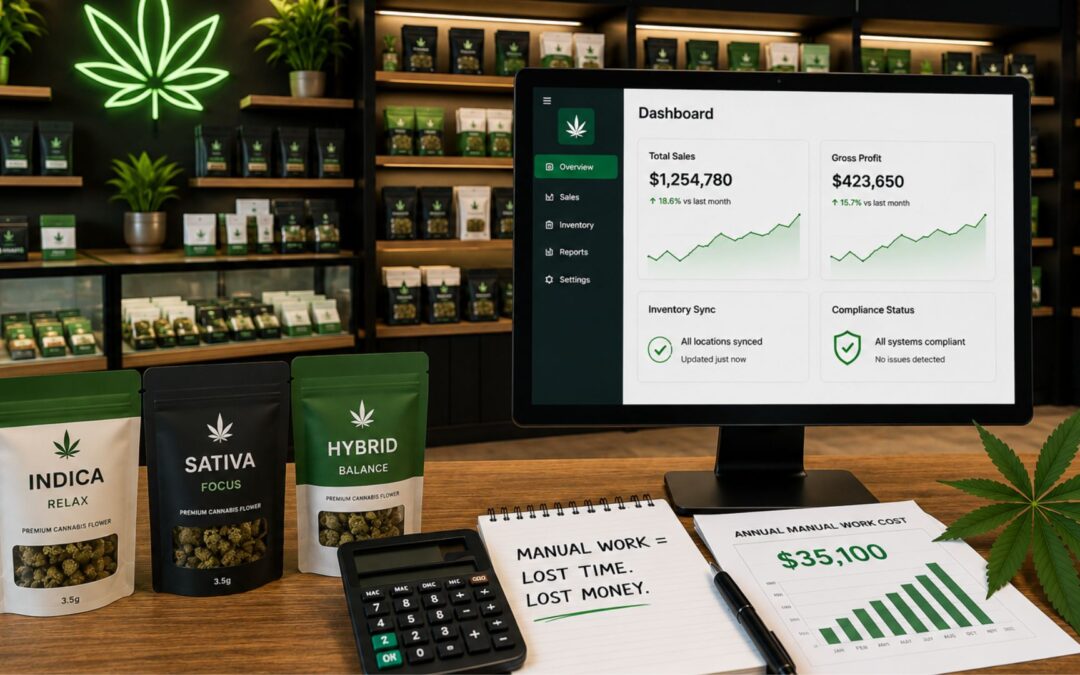
The operators outperforming their markets aren't working harder. They've eliminated the manual layer entirely. If you're running three locations and your team still spends part of every week exporting spreadsheets, reconciling cash counts by hand, and pushing price updates store by store, you're paying a tax that doesn't show up on your income statement. This article puts a number on it and shows what happens when you remove it.
The Manual Layer Tax: What Disconnected Systems Actually Cost at Scale
The manual layer is every task your team does to compensate for systems that don't talk to each other. At one location, it's annoying. At three locations, it's a budget line you've never named.
Here's a conservative estimate based on common operational patterns across Canadian and US cannabis retail:
| Task | Time Per Location / Week (Est.) | 3 Locations / Week | Annual Hours |
|---|---|---|---|
| End-of-day cash reconciliation | 1.5 hrs | 4.5 hrs | 234 hrs |
| CSV exports to QuickBooks or accounting software | 1.0 hr | 3.0 hrs | 156 hrs |
| Pricing updates pushed location by location | 1.0 hr | 3.0 hrs | 156 hrs |
| Inventory discrepancy investigations | 1.0 hr | 3.0 hrs | 156 hrs |
| Total | 4.5 hrs | 13.5 hrs | 702 hrs |
At an estimated blended rate of $50 per hour for manager-level time, 702 hours equals $35,100 annually. That figure doesn't include the cost of errors: a pricing discrepancy across three locations during a promotional period, or a compliance report filed with stale inventory data. Those carry their own penalties. For context on what compliance gaps can cost, see our breakdown of the true cost of compliance penalties and downtime.
The manual layer isn't a people problem. It's a systems architecture problem. And it scales in the wrong direction as you grow.
What Automation Actually Replaces: A Real Operational Day, Before and After
Abstract efficiency claims don't help you plan a technology decision. A task-by-task comparison does.
End-of-Day Reconciliation
Before: A closing manager counts the till, records cash totals on a paper sheet or local spreadsheet, and emails it to the operations manager. The operations manager consolidates three location reports the next morning. Discrepancies get investigated the day after that, meaning a cash variance from Tuesday doesn't surface until Thursday.
After: The POS closes the drawer, auto-reconciles against transaction totals, flags variances above a defined threshold, and logs the result to a central dashboard. The operations manager sees all three locations' close status by 11:00 PM without opening an email. Time saved per close: approximately 35 to 45 minutes across the organization.
Inventory Sync Across Locations
Before: Each location runs its own inventory count. Stock transfers between locations require manual entry on both ends. A budtender at Location 2 can't confirm whether a product is in stock at Location 3 without calling. Returns and write-offs are tracked locally, creating a system where no one has a complete picture. For a deeper look at inventory discipline, see best inventory management strategy for dispensaries.
After: Inventory updates in real time across all locations the moment a transaction is completed. Transfers are logged automatically. The operations director sees a consolidated stock view without running a single report manually. Shrinkage investigations that previously took two to three hours now take under 20 minutes because the data trail is intact and timestamped.
Payroll Data to ADP or Ceridian
Before: A manager exports shift hours from the POS, cross-references the schedule, adjusts for clock-in anomalies, and sends a formatted file to payroll. This process runs weekly across three locations and takes an estimated two to three hours total, with a meaningful error rate when hours are entered manually.
After: Hours flow directly from the POS into payroll software with no manual handoff. Exceptions are flagged for human review rather than requiring a full audit each cycle. Estimated time reduction: 80 to 90 percent of the manual payroll prep step.
The Multi-Location Reporting Gap: Why Tuesday Morning Feels Like a Second Job
Operators running three or more locations without a unified reporting layer typically spend the first part of their week building the picture that should already exist. The process looks like this: export the sales report from Location 1, export inventory from Location 2, pull the labor report from the scheduling tool, open a master spreadsheet, and start combining columns. By the time the P&L is assembled, it's already 48 hours stale.
Canadian multi-unit retail benchmarks from sectors like food service and pharmacy suggest that operators with unified dashboards make margin-affecting decisions an average of three to five days faster than those relying on consolidated spreadsheets. In a market where margin compression is a documented trend across both Canadian and US cannabis retail, three to five days is not an abstract advantage.
What a real-time dashboard changes:
- Revenue per location visible by hour, not by day-after report
- Basket size and units per transaction compared across locations without manual calculation
- Staff performance metrics tied directly to transaction data
- Inventory turn rates that flag slow-moving SKUs before they become a write-off
- Compliance status visible at the location level, not pieced together after an inspection notice
For operators preparing for provincial compliance reviews, having this data current and accessible is not optional. Our guide on preparing for provincial cannabis compliance inspections outlines exactly what regulators look for and why real-time records matter. The role of analytics in budget planning becomes significantly more practical when your data isn't two days old.
Onboarding Speed as a Competitive Signal: What "Live in Under an Hour" Actually Means
The industry average for onboarding a new cannabis retail location to a POS system runs two to three weeks. That window includes hardware configuration, menu upload, staff training, compliance integration, and go-live validation. For most operators, this creates a planning constraint that shapes expansion timelines, franchise agreements, and acquisition integration schedules.
TechPOS supports new location onboarding in under an hour for operators already on the platform. The practical implications of that gap are significant:
Franchise Expansion
A franchise model that requires three weeks of POS onboarding per new unit limits how many locations can open in a given quarter. At under an hour, a franchisee can be transacting on opening day, with compliance reporting active from the first sale.
Seasonal and Pop-Up Operations
Temporary retail formats, including event-based or seasonal locations, are only operationally viable if the technology can match the timeline. A two-week onboarding process makes a four-week pop-up impractical. An hour-long setup makes it a standard play in your expansion toolkit.
Acquisition Integration
When you acquire an existing retail operation, every week the acquired location runs on a different system is a week you're operating without consolidated visibility. For Canadian operators navigating acquisitions in active markets, that delay has a direct cost in management time and reporting accuracy. Our analysis of scaling cannabis retail operations goes deeper on the infrastructure decisions that determine whether growth creates value or just complexity.
To understand the full hardware picture at a new location, POS hardware for cannabis retailers covers what a production-ready setup actually requires.
Audit Your Own Manual Layer: Three Questions to Answer Before Your Next Leadership Meeting
You don't need a consultant to identify where your manual layer is costing you. These three questions will locate it in under ten minutes.
- How many hours per week does your team spend moving data between systems? Count exports, copy-paste steps, email handoffs, and manual data entry into any tool that doesn't receive data automatically. Multiply by your blended hourly rate and annualize it.
- How old is your most recent complete P&L across all locations when you actually read it? If the answer is more than 24 hours, you're making decisions on lagging information. Identify the specific step in your reporting process that creates the delay.
- If you needed to open a fourth location in 30 days, what would break? Walk through your current onboarding process and identify every step that requires a human to manually configure, enter, or transfer data. Each one is a constraint on your growth rate.
If any of these answers made you uncomfortable, the issue isn't your team. It's the architecture underneath them.
Frequently Asked Questions
How realistic is the $35,100 annual cost estimate for three locations?
The estimate uses 4.5 hours of manager-level manual work per week across three locations at $50 per hour, totaling 702 hours annually. These are conservative figures. Operators with more complex inventory or higher labor costs will see larger numbers. The calculation excludes error-related costs, compliance risk, and the opportunity cost of time that could go toward staff development or revenue-generating activity.
Does real-time inventory sync work across provincial boundaries in Canada?
Yes, provided the POS is built to handle provincial regulatory frameworks independently at each location while reporting into a unified back-end. The compliance rules for inventory reporting differ between provinces like Ontario, Alberta, and BC, so the system needs to handle each location's regulatory requirements locally while still aggregating data centrally. Cannabis-specific POS platforms built for Canadian multi-unit retail handle this by design. Generic retail POS systems typically do not.
What payroll platforms integrate directly with cannabis POS systems?
ADP and Ceridian are the most common integrations in Canadian cannabis retail. In the US market, Gusto and Paychex are frequently referenced. The key question is whether the integration is a direct API connection or requires a manual file export step. A file export that still requires human intervention is not automation. It's a shorter version of the manual process.
Is a one-hour onboarding timeline realistic for a location with a full product catalog?
For operators already on TechPOS, yes. The catalog, pricing rules, and compliance settings replicate from existing locations rather than being rebuilt from scratch. For a first-time setup, the timeline is longer, but structured onboarding support compresses it significantly compared to the industry average. The installation process is documented and repeatable, not dependent on on-site technical staff at each location.
At what point does investing in integrated systems stop making financial sense?
The math changes at single-location operations with very low transaction volume, where the manual layer is thin enough that the cost of integration exceeds the time saved. For any operator running two or more locations with consistent daily sales volume, the break-even on integrated systems is typically reached within the first quarter. Beyond two locations, the ROI case becomes straightforward because the manual layer grows faster than revenue as you scale.
Find Out Exactly Where Your Manual Layer Is Costing You
The three-question audit above gives you a starting point. A structured review goes further. Our team works through your current reconciliation process, reporting setup, and onboarding workflow to identify where time and money are leaving your operation without a line item to show for it.
There's no pitch involved. You leave with a clear picture of your manual layer cost and what eliminating it would require. To see what the platform handles before the call, review the TechPOS features or check TechPOS pricing for your location count.
When you're ready to put a number on what your current setup is costing, book a free TechPOS audit. The conversation takes 30 minutes. The findings tend to be worth a lot more than that.