
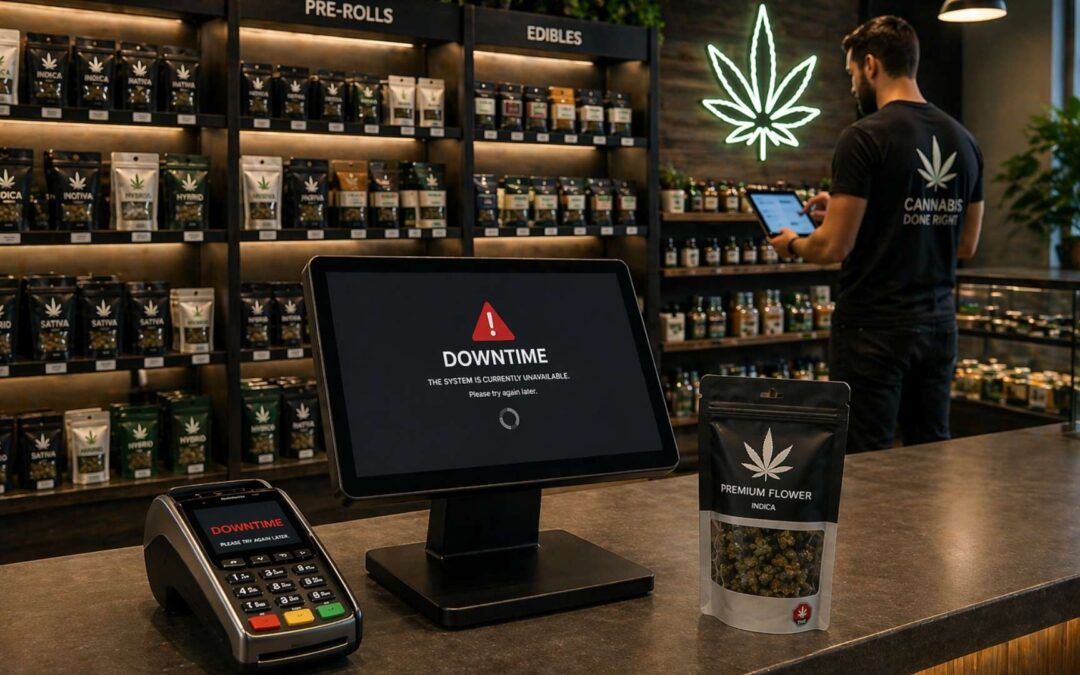
The true cost of a cannabis POS depends on far more than its monthly subscription price — it includes compliance failure penalties, revenue lost during outages, and hidden fees that only appear after you’ve signed a contract. A dispensary running on the wrong system risks regulatory fines from bodies like the AGCO, BCLDB, and AGLC, as well as lost sales every time the system goes down. TechPOS builds its cannabis POS around provincial compliance and uptime reliability, so retailers aren’t caught off guard by costs that should have been avoidable. Understanding where these costs come from is the first step toward choosing a system that protects your licence and your revenue.
Key Takeaways: Cannabis POS True Cost — Compliance Penalties and Downtime
- Compliance fines tied to POS inaccuracies can range from thousands of dollars for minor violations to hundreds of thousands for serious ones.
- System downtime during peak sales periods, like 4/20, can cost a dispensary significant revenue within hours if the POS cannot continue processing offline.
- Advertised cannabis POS pricing rarely includes hardware, installation, payment processing fees, or ongoing integration costs.
- A cannabis-specific POS with provincial banking and reporting integration prevents the tracking gaps that trigger regulatory audits.
- Fragmented software setups — using separate tools for inventory, ecommerce, and POS — multiply operating costs through added IT, integration, and staffing overhead.
- Generic retail POS systems cannot meet the mandatory provincial reporting requirements that Canadian cannabis licences depend on.
- Offline mode is a compliance and revenue protection feature, not a convenience — dispensaries without it risk both lost sales and incomplete audit trails during outages.
Compliance Failures Cost Cannabis Retailers Far More Than the Fine Itself
A compliance failure tied to POS inaccuracies can trigger financial penalties that dwarf the cost of the software itself. Cannabis compliance fines for violations linked to inventory tracking or point-of-sale inaccuracies can range from $5,000 for minor issues to $200,000 for serious violations such as selling to minors. For a new independent dispensary working with a tight first-year budget, even the lower end of that range can be devastating. Multi-location operators face compounding exposure — a single systemic POS error can produce violations across several stores simultaneously.
Does a POS Error Qualify as a Compliance Violation Under Canadian Cannabis Law?
A POS error becomes a compliance violation the moment it produces inaccurate seed-to-sale tracking data or missing transaction records in a provincial report. A Maryland dispensary operating as Storehouse received a $10,000 fine from state regulators after an inspection revealed POS-linked tracking failures, including falsified records and employee product diversion. Closer to the Canadian market, five cannabis companies were collectively fined $360,000 for selling recreational products during medical-only hours, with individual fines reaching $90,000 at a rate of $10,000 per day. Financial recovery from fines at that scale can take months, and the reputational damage with regulators can affect licence renewal long after the fine is paid. It’s also worth noting that compliance risk extends beyond the POS terminal itself — a Vermont cannabis cultivator received a $20,000 fine tied to an Instagram post depicting an unlicensed delivery, which illustrates how broadly regulators define operational compliance.
POS System Downtime Drains Dispensary Revenue in Ways That Never Appear on an Invoice
A cannabis POS outage doesn’t just pause sales — it creates an immediate chain reaction of lost revenue, frustrated customers, and potential compliance gaps. Dispensaries that rely on a POS without offline mode lose the ability to record transactions during internet outages, which means every sale during that window is untracked. A single-location store during a busy Friday afternoon can lose thousands of dollars in revenue within a few hours if the system can’t continue processing. Larger operations face an even steeper hit, since staff across multiple registers simultaneously lose the ability to serve customers.
Why Do Payment Processing Outages Hit Dispensaries Harder Than Other Retailers?
Cannabis dispensaries are more vulnerable to payment processing outages than general retailers because most still operate in a heavily cash-dependent environment, with limited payment fallback options when card systems fail. Payment processing disruptions affecting over 1,000 cannabis dispensaries led to dropped ticket sizes, long ATM lines, and immediate revenue impact — with even a few days without card options causing measurable lost sales and reputational damage. Switching customers to cash-only during an outage rarely offsets the full revenue loss, since many customers leave rather than visit an ATM. Online orders are also affected: integrated cannabis ecommerce orders show 35% higher average order values compared to walk-in purchases, so any outage that cuts off online order fulfillment eliminates a disproportionately large share of revenue per transaction.
Advertised Cannabis POS Pricing Leaves Out the Costs That Matter Most to Operators
The price listed on a cannabis POS vendor’s website is rarely what a dispensary actually pays by the end of its first year. Dispensary POS software pricing typically ranges from starter systems at $99–$150 per month to mid-tier platforms at $350–$600 per month, with first-year total budgets for new shops often reaching $3,000 to $10,000 when including hardware and launch services. Hardware alone adds $1,000 to $3,000 per POS station for essentials like touchscreen tablets and registers. Beyond hardware, payment processing fees for cannabis software typically add 2–4% on top of monthly subscription costs, creating a recurring variable expense that grows with sales volume. A dispensary processing high monthly sales volume can find that payment processing fees alone exceed its software subscription cost.
Cannabis POS Costs That Vendors Rarely List Upfront
- Hardware costs typically add $1,000 to $3,000 per register station on top of the software subscription.
- Installation and setup fees can reach up to $1,000 per location, billed separately at contract signing.
- Payment processing fees typically range from 2% to 4% of transaction value and scale with monthly sales volume.
- Provincial compliance integration — such as AGCO or BCLDB reporting — may require a higher-tier subscription plan or a separate integration fee.
- Multi-location operators often pay per-store licensing fees, which multiply total annual cost significantly beyond what a single-store quote shows.
- Third-party integrations for loyalty, ecommerce, or analytics can add separate monthly subscription costs if the POS doesn’t include these natively.
- Annual software updates and IT support contracts are commonly billed separately from base subscription pricing.
How Does Running Multiple Disconnected Software Tools Multiply a Dispensary’s Operating Costs?
Dispensaries that manage inventory, ecommerce, digital signage, and POS through separate platforms pay more than the sum of each tool’s subscription. Cannabis POS systems with advertised low monthly pricing frequently carry additional incidental fees such as installation and setup that can reach up to $1,000, making the real first-month cost much higher than the headline rate. Fragmented use of multiple dispensary software systems increases total cost of ownership through added integration, customization, IT support, and update expenses that go well beyond individual subscription fees. Consolidating onto a single platform that handles POS, cannabis ecommerce, inventory, and compliance in one system removes these compounding costs — dispensaries can achieve meaningful monthly savings by reducing staffing needs, tool fragmentation, and the compliance overhead that disconnected systems generate.
Generic POS Systems Cannot Meet the Regulatory Integration Demands of Canadian Cannabis Retail
A standard retail POS system built for coffee shops or clothing stores isn’t equipped to handle the compliance demands of a cannabis licence. A generic retail point-of-sale system will not suffice for most cannabis businesses, since they require custom systems that integrate with mandated governmental tracking and specialized software. For Ontario retailers, the AGCO integration is not optional — it’s a licence condition. For BC retailers, the BCLDB reporting system sets the same standard, and for Alberta, the AGLC applies the same requirement. Retailers who try to use a generic system typically find themselves exporting data manually, which introduces human error and delays that regulators treat as compliance failures.
What Happens to a Dispensary’s Licence When Its POS Cannot Submit Accurate Government Reports?
When a POS system fails to submit accurate provincial reports, regulators don’t just issue a warning — they begin building a compliance record that can affect licence renewal and standing. Ontario dispensaries using AGCO-connected POS reporting avoid the manual data-gathering process that creates gaps and delays in regulatory submissions. A dispensary that manually exports data from an incompatible POS risks submitting reports with inventory discrepancies, which provincial inspectors flag as systemic compliance failures rather than isolated data entry mistakes. Retailers who switch cannabis POS systems after inventory discrepancies often report that the inaccuracies were caused by a lack of native provincial integration in their previous platform.
Offline Mode Separates Compliant Cannabis POS Systems From Expensive Liabilities
Offline mode isn’t a premium feature — it’s a baseline requirement for any cannabis POS that takes compliance seriously. Reliable cannabis POS platforms with enterprise-grade infrastructure emphasize 100% uptime on high-volume days, since system crashes during peaks result in lost profits, eroded customer trust, and heightened compliance exposure from incomplete tracking. A dispensary without offline capability during an internet outage can’t record sales, can’t track inventory movements, and can’t maintain the transaction log that provincial inspectors audit. For smaller single-location stores, a brief outage on a busy Saturday afternoon can produce the same compliance gap as a much longer failure at a quieter time.
Why Is POS Uptime a Compliance Issue and Not Just an Operations Problem?
Every unrecorded sale during a POS outage creates a gap in the seed-to-sale data chain that regulators require cannabis retailers to maintain continuously. A robust cannabis POS with offline mode capability must continue recording sales and maintaining inventory tracking during network outages, preventing both immediate revenue loss and potential compliance gaps from unrecorded transactions. An unrecorded sale isn’t just a missing data point — it’s a discrepancy between physical inventory and reported inventory, which is exactly what provincial auditors look for during inspections. Enterprise cannabis POS uptime infrastructure ensures that high-volume days don’t create compliance exposure through system crashes, protecting both the day’s revenue and the retailer’s regulatory standing.
TechPOS is built to address every cost category covered in this article — from native AGCO, BCLDB, and AGLC compliance integrations that eliminate manual reporting errors, to SOC 2 certified infrastructure that keeps your system running when it matters most. If you’re evaluating your current setup or planning your first dispensary, explore how a cannabis analytics and POS platform built for compliance can reduce the real costs that generic systems leave you exposed to. The right system doesn’t just process sales — it protects your licence, your revenue, and your long-term viability as a retailer.