
5 Cannabis Retail Beliefs That Sound Right and Cost You Scale
Every operator I talk to believes at least one of these. Most believe three. That is not a criticism. These beliefs formed for good reasons, in an earlier version of this industry, and they made operational sense when the market was simpler. The problem is that cannabis retail in Canada has changed faster than the mental models operators use to run it, and beliefs that were reasonable in 2018 are quietly costing money and scale in 2025.
Why Good Beliefs Go Bad When Markets Mature
Canada's Cannabis Act came into force in October 2018. In those first months, a licensed store in Ontario might carry 60 to 80 SKUs, all sourced through a constrained OCS catalogue. A budtender who worked every shift for three months could genuinely know the entire menu. The store had one location. The owner was probably on the floor. Informal knowledge worked because the system was small enough to hold in a single person's head.
That version of the business is gone. The OCS catalogue now lists well over 1,500 products. Alberta's AGLC-regulated open market has pushed SKU counts higher still. Multi-location groups have expanded across provinces, each with different provincial compliance requirements, different distributor relationships, and different customer bases. The old beliefs did not update when the market did.
What follows is not a list of operator failures. It is a correction, offered the way a useful audit should be: specific about what the belief is, honest about why it spread, and clear about what to hold instead.
Myth One: Your Team Knows the Menu
This one is almost universal, and it comes from a real operational truth. In the early days of Canadian cannabis retail, verbal product knowledge was the training model because it was the only practical one. Regulatory restrictions on promotion meant you could not put detailed product information on a digital menu board. LP sales reps were not yet in stores. Budtenders learned by handling product, reading packaging, and talking to each other. That culture of conversational expertise became the identity of good cannabis retail.
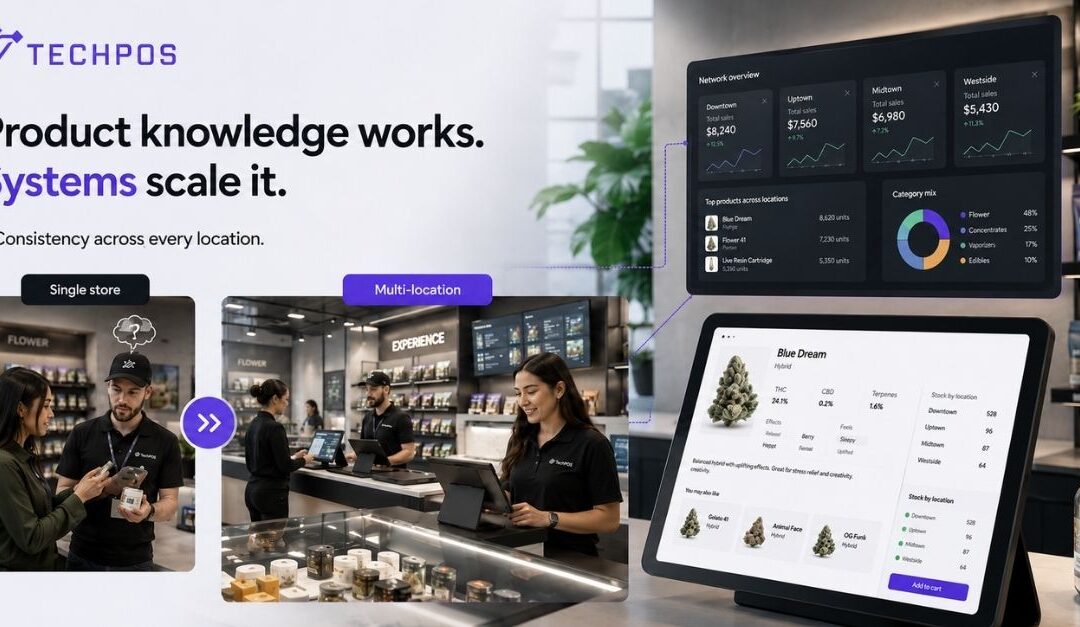
The problem is scale. When your store carries 400 or more active SKUs, no individual staff member knows the full menu. They know the 40 or 50 products that moved through their shifts in the last few weeks. They know the items they personally use. The rest of the catalogue exists in a kind of institutional fog, accessible only if a customer asks exactly the right question to exactly the right person on exactly the right shift.
Open a second location and the fog doubles. The budtender at your new store in a different neighbourhood has never absorbed the product intuitions your original team built over two years. There is no mechanism to transfer that knowledge systematically because it was never captured systematically. As budtender education and training programs become more structured, operators are discovering that informal knowledge is not a foundation, it is a liability that compounds with each new hire and each new location.
The sharper belief: product knowledge that lives only in your staff's heads cannot travel to a second location, survive a staff turnover wave, or keep pace with a catalogue that changes every OCS release cycle.
Myth Two: The Best Stack Is a Collection of Best-in-Class Tools
This belief has an understandable origin. The first generation of all-in-one cannabis POS solutions, built in haste to serve a newly legal market, were not good. Operators who adopted them early got burned by compliance gaps, unreliable reporting, and integrations that did not work as advertised. The rational response was to build a stack: one tool for inventory, another for loyalty, a third for analytics, a fourth for compliance reporting to bodies like the AGCO in Ontario or the AGLC in Alberta.
That response made sense in 2019. It is causing real problems in 2025.
The core issue is data fragmentation. When your loyalty data lives in one platform, your sales data in another, your inventory in a third, and your compliance records in a fourth, you do not have four strong systems. You have four incomplete pictures that reconcile with each other imperfectly, on a lag, and only when someone manually exports and imports files across platforms. Every time data crosses a boundary between systems, there is a chance for it to arrive wrong, late, or not at all.
Multi-location operators running disconnected stacks describe a specific recurring problem: end-of-month reporting becomes a reconciliation project rather than a business review. Staff spend hours verifying that what the POS recorded matches what the inventory system shows, which should match what was reported to the provincial regulator. When those numbers disagree, finding the source of the discrepancy across four platforms is genuinely difficult. This is not a hypothetical. If you are running a disconnected stack across two or more locations and filing compliance reports to the OCS, AGLC, or BC Cannabis Stores, you have almost certainly experienced a version of this.
The comparison worth making with the US market is instructive: state-licensed operators in markets like California and Colorado who built sprawling multi-tool stacks in the early years have largely moved toward consolidated platforms, not because integrated solutions became fashionable, but because the operational cost of maintaining disconnected data became unsustainable at scale. You can read more about what drives these decisions in our breakdown of the key factors operators weigh when choosing a cannabis POS system.
Still running four separate tools and wondering where your data actually lives? Book a free TechPOS audit and we will map your current stack against what your operations actually need at your scale.
The sharper belief: a stack of disconnected best-in-class tools is only best-in-class at the tool level. At the business level, the integration gaps between them are where accuracy, time, and margin go to disappear.
Myth Three: Loyal Customers Come Back Because of Your Staff
This one deserves careful handling because it contains a real truth. Great staff do drive loyalty. A knowledgeable, personable budtender who remembers a customer's preferences, recommends the right product, and makes the person feel seen is genuinely valuable. That kind of service earns repeat visits. It is not nothing.
But here is what that version of loyalty actually is: it is a relationship between one customer and one employee, in one location, on the shifts when that employee is working. It is not a relationship between the customer and your business.
When that employee leaves, and in cannabis retail, turnover is real, the relationship walks out with them. When the customer visits your second location, they start from zero. Your loyalty program, if it is built on staff memory rather than a system that captures and surfaces customer data, does not travel. It does not remember that this customer prefers indica-dominant concentrates, dislikes anything with high myrcene content, and always buys around the long weekend before Victoria Day. The next budtender has no idea. The customer notices, even if they do not say so.
System-driven loyalty looks different. It means that when a customer walks into any of your locations, regardless of who is on shift, the person serving them has immediate access to purchase history, product preferences, and loyalty points. It means that a promotion triggered by a milestone, say a customer's tenth visit, fires automatically without requiring a staff member to remember. It means that the relationship is with the brand, not with the individual behind the counter.
This does not replace great staff. It makes great staff more effective by giving them information they could not otherwise have. A budtender who knows a returning customer's history without having served them before is not just efficient, they appear to genuinely know the customer. That is the experience that builds real retention. Our guide on cultivating cannabis customer loyalty goes deeper on how the structural elements of a loyalty program determine long-term revenue, separate from the quality of individual staff interactions.
The sharper belief: staff-driven loyalty is real but fragile. System-driven loyalty is what allows the relationship to survive staff turnover, a second location, and a long weekend when your best budtender calls in sick.
What the Numbers Suggest About Operational Fragmentation
Estimated share of manager time consumed by cross-system data reconciliation tasks, by number of locations. Based on operator interviews and internal TechPOS onboarding assessments. Figures are estimates.
The pattern above reflects what TechPOS sees consistently during onboarding audits. A single-location operator running a disconnected stack spends a meaningful but manageable share of management time on reconciliation. At two locations, that share roughly doubles because every discrepancy now has twice as many places to originate. At three or more locations, reconciliation stops being a task and starts being a job. Operators in this position are often hiring for it without realizing that is what they are doing.
For context on what fragmented operations cost across a full year, the analysis in how multi-location cannabis retailers lose $35,000 a year to manual workflows puts specific CAD figures to this pattern using Canadian retail assumptions.
The Beliefs Worth Keeping, and the Ones to Retire
To be direct about what operators should carry forward and what to set down:
| The Belief to Retire | The Sharper Belief to Hold Instead |
|---|---|
| Your team knows the menu. | Your team knows the part of the menu they have personally encountered. The rest requires a system that surfaces it at the point of sale. |
| A best-in-class stack beats an integrated platform. | Best-in-class tools produce best-in-class data silos. Integration gaps are where your accuracy and your margin go. |
| Loyal customers come back because of your staff. | Loyal customers come back because of how your business makes them feel across every visit, every location, and every shift. That requires a system, not a hope. |
| More locations means more of the same. | Each new location multiplies the complexity of every operational gap you have not yet fixed. |
| Compliance is a back-office task. | Compliance flows from the transaction forward. If your POS is not capturing it correctly, your reports to the OCS, AGLC, or BCLDB are wrong before you touch them. |
The fifth belief in the table, about compliance, is worth a brief note. Canadian operators file provincial compliance reports with real consequences attached. An error in a report to the AGCO in Ontario or the AGLC in Alberta is not an administrative inconvenience. It is a licence risk. When compliance data originates in one system and gets re-entered into another before filing, the probability of error increases with every manual step. One-click AGCO compliance reporting and one-click AGLC compliance reporting exist precisely because that manual step is where errors enter the process.
None of these beliefs make operators foolish. They make operators human. The market that formed these beliefs no longer exists, and the operators who will scale successfully in the next phase of Canadian cannabis retail are the ones willing to audit their assumptions with the same rigour they apply to their inventory. If you want to understand what that audit looks like in practice, the breakdown of how cannabis retailers scale their businesses is a useful starting point.
Frequently Asked Questions
How many SKUs does a typical Canadian cannabis store carry today compared to when the market opened?
In 2018 and early 2019, most licensed Canadian retailers carried between 60 and 100 SKUs, limited by constrained LP supply and provincial catalogue restrictions. Today, stores in competitive markets like Ontario and Alberta routinely carry 300 to 500 active SKUs, with some high-volume urban locations managing catalogues above that. The OCS alone lists over 1,500 products, though individual store ranging is a subset of that total. The scale difference fundamentally changes what staff can realistically know without system support.
What does data fragmentation actually cost a multi-location operator?
The cost is mostly hidden in time, which is why it is easy to underestimate. Managers reconciling sales data across disconnected systems, staff re-entering inventory counts that should transfer automatically, and owners rebuilding reports from exports that should already be consolidated: these are salary costs that do not appear on a technology budget line. Conservative estimates for a two-location Canadian operator running a disconnected stack put the annual cost of manual workflow overhead in the range of $20,000 to $40,000 CAD, depending on staffing structure and how many systems are in play.
Is staff-driven loyalty actually a problem if my turnover rate is low?
Low turnover reduces the risk, but it does not eliminate it. Even with stable staff, loyalty that depends on individual relationships does not transfer to new locations, does not fire promotional triggers automatically, and does not produce the customer data that lets you make inventory and marketing decisions. The ceiling on staff-driven loyalty is the ceiling on what one person can remember and act on. System-driven loyalty has no equivalent ceiling.
What should operators look for when evaluating whether their current stack is creating problems?
Three signals are reliable. First, if preparing a compliance report to the AGCO, AGLC, or another provincial body requires pulling data from more than one system, the process has unnecessary risk. Second, if a customer's loyalty points or purchase history are invisible to staff at one of your locations, your loyalty program is not a loyalty program. Third, if your monthly inventory reconciliation takes more than a few hours for a single location, the data is not flowing cleanly between your systems. Any one of these is worth fixing. All three together indicates a structural problem.
How does an integrated POS platform handle provincial compliance differently than a disconnected stack?
An integrated platform captures compliance-relevant data at the point of transaction. Age verification, sale quantities relative to the federal possession limits under the Cannabis Act, product category recording, and daily sales totals all flow from the transaction into the compliance report without a manual export or re-entry step. When the data originates in the same system that produces the report, the chain of custody is shorter and the error risk is lower. Operators in Ontario and Alberta filing with the AGCO and AGLC respectively have particularly clear evidence of this difference when they compare the time and error rate of manual versus integrated filing. You can read more about what the provincial cannabis compliance inspection process actually examines and how operators can prepare for it.
Find Out Which Beliefs Are Costing Your Operation
TechPOS works with Canadian cannabis retailers across Ontario, Alberta, British Columbia, and beyond. If you are running more than one location, planning to open a second, or simply want an honest look at whether your current stack is holding you back, the conversation starts with a 30-minute call.
Ready to find out where the gaps actually are in your operation? Book a free TechPOS audit and get a clear picture of what your stack is doing and what it is not. You can also review TechPOS features or check TechPOS pricing before the call if you prefer to come prepared.
The operators who scale Canadian cannabis retail in the next five years will not be the ones who believed the right things in 2018. They will be the ones who were willing to examine what they believed in 2025.